In one of my Facebook groups, another writer posed the question, “How do you draw your inspiration for your stories?” The answers ran the gamut. I posted: “My best ideas come while lingering far too long in the shower.”
This is 100% true. I am a bathroom-inspired genius, in part because this is what I see out my bathroom window:
 There’s a fog; it’s early AM; I live in the Pacific Northwest where it’s typically gloomy this time of year. Ghostly would be another apt description, but more on that later.
As I gaze out, I often wonder what lives in that wildlife habitat. I hear coyotes at night, and I’ve seen deer before, but I’m not really out in the country per se, just lucky to butt up against a wisp of nature.
Now, I’m not claiming that everything conceived in the bathroom has life outside the bathroom or even lives up to its initial hype, just that my bathroom is a petri dish for ideas.
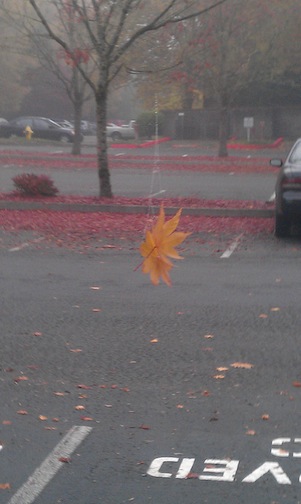 I also tend to notice oddities like this leaf I saw suspended by a few spider web filaments. It survived the entire day dangling in the parking lot over one of the spots reserved for Evergreen Health Care, so I had to snap a picture:
|
|
|
|
|
|
|
|
|
 .
.
 Once I snapped a photo in my brand new (at the time) house and my sister helpfully pointed out that I had orbs. That took my imagination in a whole new direction. To this day, there’s something a little creepy about my basement, more so the guest bedroom than my workout room (pictured), though I must have the TV going at all times, either with my DVD workout playing or something mindless like QVC.
So with those types of photos / experiences, you’d think I’d write horror. I don’t. I can, but I prefer other genres. Most of the time.
Sometimes a kernel of an idea will implant from sights like these, or a song, or a story I hear. Over time, the idea germinates and takes off. Maybe it grows into a full tree, maybe it’s merely a sprig of cilantro or mint for spicing up a bigger dish.
When I do flash fiction, the conception of a story idea under the pressure of a ticking clock is quite an adrenalin rush. While my stories haven’t always been that well polished in the rush to get them down within the 90 minutes (and I’m usually finished in closer to 60 minutes because I hate to edit), the stories themselves stick with me in a good way.
So, this AM, I’m sitting down to take one of those 500 word acorns to see if I can grow it into something bigger for an anthology, something closer to 5000 to 10,000 words. I may need to take a long shower or go workout in my haunted gym first…but I’ll get it down. I pitched my idea to the Silverback this morning before we hauled out of bed for the day. He was either humoring me because he liked my idea or was buttering me up for [[censored]], but he responded favorably. 😉
So how about you? Where, when and how do your best ideas come to you for problem solving, story writing, artwork, whatever?

 Claire Gillian